Who’s standing up for the Amazon?
A new public campaign calls on major retailers and food-service businesses to defend the Amazon Soy Moratorium (ASM) and move to 100% deforestation- and conversion-free (DCF) soy now, rather than years from now.
For nearly two decades, the ASM has been one of the main safeguards against soy expansion into Amazon forests. The agreement established that traders would not buy soy grown on land cleared after July 2008. During its first decade, it kept around 17,000 km² of Amazon forest out of soy production and, by 2023, 97.5% of soy planted in Mato Grosso’s Amazon region was on land cleared before the 2008 cut-off date.
In January 2026, ABIOVE and around 20 traders left the agreement. A peer-reviewed study published in Science warns that dismantling it could expose up to 1.4 million hectares of additional Amazon rainforest to deforestation by 2036, despite the availability of already degraded land for agricultural expansion. In August 2026, Brazil’s Supreme Federal Court confirmed that the ASM is constitutionally compatible and ordered the termination of judicial and administrative proceedings based on claims that the agreement was illegal or anti-competitive.
Where Mato Grosso’s Amazon soy is grown
In 2023, 97.5% of the soy area on farms of at least 25 ha was located on land cleared before July 2008; the remaining 2.5% was on land cleared after the cut-off date.
The frontier: what are we seeing on the ground?
Mato Grosso is Brazil’s largest soybean-producing state. For the 2025/26 crop, the National Supply Company (Conab) estimated production at 51.6 million tonnes, approximately 28.6% of Brazil’s total. Against this backdrop, Mighty Earth and Instituto Centro de Vida (ICV) are monitoring agriculture-driven deforestation in the Mato Grosso Amazon, particularly around infrastructure operated by major soy traders.
The briefing identifies 41 agriculture-driven clearing cases, covering 16,869 hectares, within 50 km of silos operated by ADM, Amaggi, Bunge, Cargill and COFCO. Twelve cases show evidence of crops planted in recently cleared areas during the 2025/26 growing season, covering 4,889 hectares. A further six farms cleared 2,663 hectares while already cultivating more than 5,200 hectares of soy.
These findings show areas of emerging risk, but do not demonstrate that traders are buying soy from these areas or, on their own, establish non-compliance with the ASM.
Who is meeting their commitments?
The following analysis covers eight major companies – Casino, Carrefour, Lidl, Aldi Nord, Aldi Süd, Sainsbury’s, Tesco and McDonald’s – whose substantial purchasing scale and consumer reach give them significant potential influence over soy and animal-feed supply chains.
Companies are assessed against six criteria:
- Public support for the ASM since 2025.
- Inclusion of all ASM criteria in the current deforestation policy.
- Current 100% DCF compliance.
- A public plan to reach 100% DCF as soon as possible.
- A public deforestation monitoring platform, including soy.
- Exclusion of suppliers that fail to meet ASM or DCF requirements.
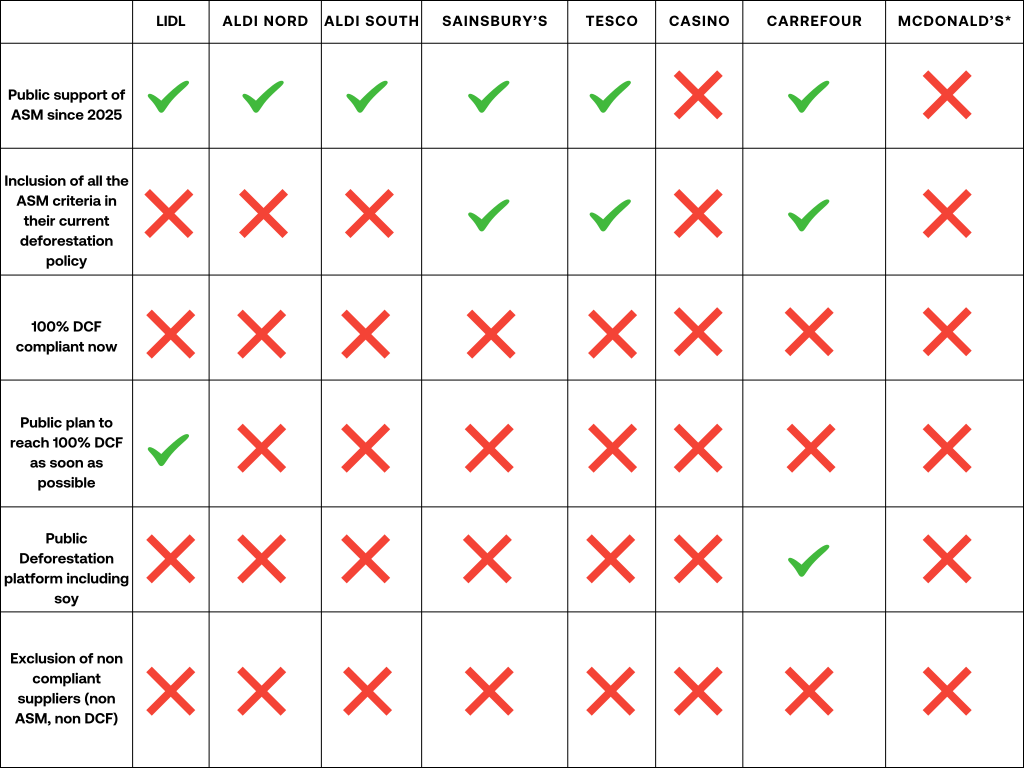
*McDonald’s is included because it helped establish the Amazon Soy Moratorium. However, its 2030 deforestation-free target is less ambitious than the ASM, and it does not explicitly endorse it. Its approach focuses mainly on supplier engagement, without clear exclusion criteria for non-compliant traders.
The analysis shows a gap between public commitments and implementation. While most companies publicly support the ASM, few have incorporated all its criteria into their current policies and none currently achieves 100% DCF compliance. None of the companies assessed currently commits to excluding suppliers that fail to meet ASM or DCF requirements.
The science shows the Moratorium works. Brazil’s Supreme Court has confirmed that companies can uphold it, and there is enough land to meet soy demand without further deforestation. So why are companies still delaying?
KEEP THE PROMISE. DELIVER DCF NOW. DEFEND THE ASM.
Companies have already committed to eliminating deforestation and conversion from their soy supply chains.
The Amazon Soy Moratorium remains the single most effective mechanism for delivering those commitments in the Amazon biome. Weakening it would make corporate zero-deforestation commitments significantly harder to achieve.
Now is the time to implement—not postpone—existing commitments.
We call on companies to:
✔ Publicly call on all soy traders to fully support and participate in the Amazon Soy Moratorium, uphold its core criteria, including the July 2008 cut-off date, and extend equivalent no-deforestation and no-conversion safeguards to other soy expansion frontiers, including the Cerrado and Bolivia.
✔ Move to 100% verified DCF soy now across all soy embedded in animal products sold by the company in all countries where it operates, based on 2008 Amazon and 2020 Cerrado cut-off dates. As an immediate step, publish a time-bound roadmap to 100% verified DCF, with clear milestones and transparent progress reporting.
✔ Phase out traders unable or unwilling to demonstrate ASM compliance.
✔ Publicly disclose implementation progress and supplier accountability.
✔ Implement a public deforestation alert and grievance mechanism across your soy supply chain, starting with an immediate investigation of the cases identified by Mighty Earth and ICV, and regularly disclose identified alerts, investigation outcomes, supplier exposure and corrective actions taken.
✔ Commit to growing the share of plant-based protein sales within overall protein sales to help reduce the impacts of animal agriculture on forests, nature and the climate.
Methodology
This tracker combines:
- Direct written responses received from companies following Mighty Earth and partners’ coalition outreach;
- Public sustainability reports and corporate sourcing policies;
- Public statements supporting (or not supporting) the Amazon Soy Moratorium;
- Responses to the ASM pledge;
- Findings from Mighty Earth and ICV’s ongoing monitoring of agriculture-driven deforestation in Mato Grosso.
The tracker will be updated regularly as new company responses, public commitments, and monitoring results become available.