Holy Cow! Ahold Delhaize investors methane warning
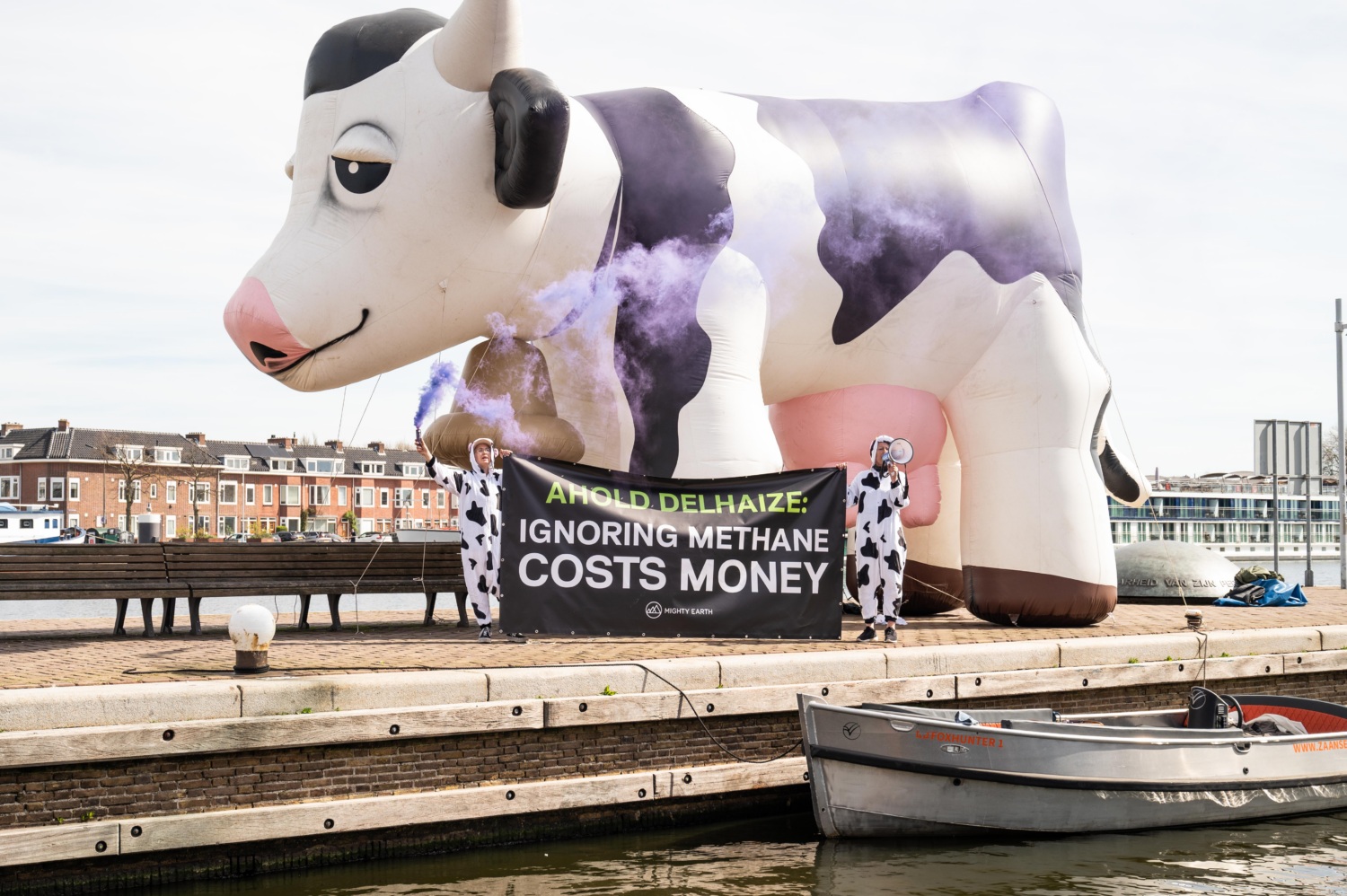
(Amsterdam, 8 April 2026) At retail giant Ahold Delhaize’s Annual General Meeting(AGM) near Amsterdam, international environmental advocacy group, Mighty Earth,staged a bold, bovine stunt to warn investors that “ignoring methane costs money.”
As delegates gathered in the foyer of the Zaantheater in Zaandam for the AGMcampaigners surprised them with a huge, methane-emitting cow to deliver the message with impact that Alhold Delhaize is not doing enough to tackle its methane emissions, which are undermining the group’s efforts to meet its 2030 climate targets, presenting both financial and reputational risks.
Mighty Earth’s Senior Director for The Netherlands, Jurjen de Waal said:
“Cows are the new coal when it comes to climate pollution with livestock farming, primarily cattle, responsible for 32% of global methane emissions.”
“Our recent analysis found that almost 44% of Ahold Delhaize’s emissions come from methane, embedded in its meat and dairy supply chains. Yet, the retailer has no plan to tackle its methane emissions.”
“The group’s investors need to know that ignoring methane costs money. That’s why took the bull by the horns today, bringing a message that couldn’t be ignored – a methane-emitting, mega cow.”
Supermarkets’ climate power
Supermarkets are uniquely positioned between food producers and consumers in the global food system and have a huge role in tackling methane emissions embedded in meat and dairy supply chains.
Ahold Delhaize is the fourth highest grossing global food retailer, headquartered in the Netherlands. It operates major supermarket brands in Europe and the U.S., including Albert Heijn, Delhaize, Giant, Food Lion and Stop & Shop. Based on global revenue, a recent Mighty Earth report revealed that Ahold Delhaize produces excessive quantities of methane from its meat and dairy products, equal to 11.7 million tons of CO₂e each year or more than the entire countries of Denmark or Sweden. The report estimates almost 44% of the group’s emissions come from meat and dairy methane.
Ignoring methane costs money
Ahold Delhaize has a 2030 target to reduce its emissions from Forests, Land Use and Agriculture (FLAG) by 30.3% compared to 2020. Reducing methane emissions from meat and dairy is needed to meet this target. However, Ahold Delhaize does not report on its methane emissions and has no methane reduction goal. Its 2025 annual report states that its FLAG emissions have increased by 5.2% compared to 2020. Failing to meet these targets will mean higher interest rates on its sustainably linked bonds and risks reputational and possibly legal implications.
Methane matters
The world has just experienced its third hottest year on record, with a key driver being methane emissions from livestock agriculture. Beef and dairy production are responsible for around 32% of all human-caused methane emissions globally.
Rapidly cutting this climate superheater is one of the fastest ways to put the brakes on global warming and to lessen the extreme climate impacts and nature loss we are already experiencing.
ends
For more information or an interview please contact:
Jurjen de Waal, Senior Director for The Netherlands (Amsterdam)
[email protected] +31 646076562
Notes to editors
Useful links:
Link to images here: https://drive.google.com/drive/folders/144877tyLpQfGALb_PlhgJZZG_4lAtGkK?ths=true
Mighty Earth’s Report on Ahold Delhaize, “Taking the bull by the horns” –https://mightyearth.org/wp-content/uploads/2025/04/Ahold-Brief-Final.pdf
Mighty Earth’s Report on Ahold Delhaize’s US brands, “The Lions Share”: https://mightyearth.org/wp-content/uploads/2025/12/The-Lions-Share.pdf
- While carbon dioxide has become synonymous with climate change, methane — a climate superheater over 80 times more potent than carbon dioxide in the short term — has yet to be sufficiently prioritized by businesses and policy makers.
- The UN Environment Programme estimates methane emissions must be reduced by 40-45% by 2030 to remain within a 1.5 C warming limit.
- Livestock accounts for approximately 60% of agricultural emissions and is the biggest single source of human-caused methane emissions, from cows used for beef and dairy.
- Cows and other ruminant animals produce methane during digestion through a process called enteric fermentation, where microbes in their stomachs break downfood, releasing methane mostly through burps.