First Borneo: Caught red-handed laundering deforestation into global palm oil supply chains
Ongoing Destruction of Orangutan Habitat and Customary Land
A Mighty Earth investigation has caught a major rainforest destroyer, the First Borneo Group, red-handed laundering palm oil into the supply chains of the world’s largest palm oil traders.
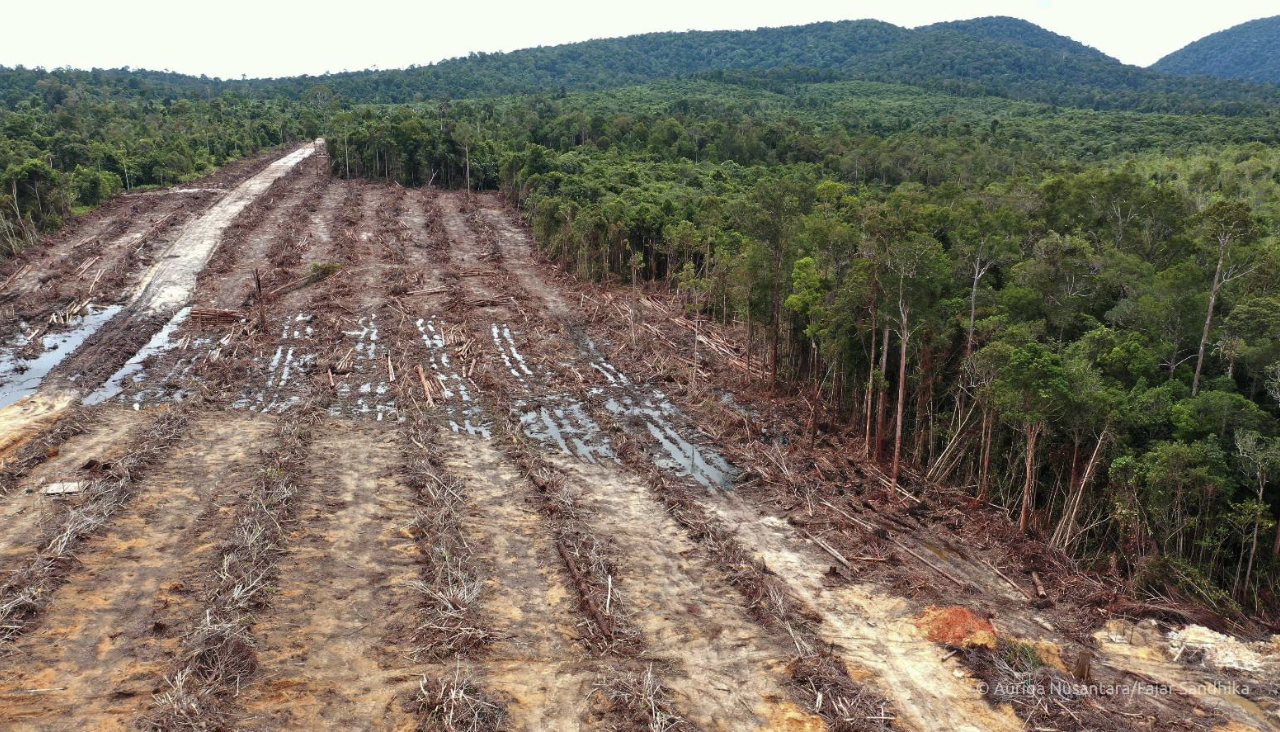
The notorious First Borneo Group is clearing thousands of hectares of orangutan habitat in its PT Equator Sumber Rezeki (ESR) concession to make way for oil palm plantations inside a UNESCO Biosphere Reserve, a biodiverse landscape within West Kalimantan part of Indonesian Borneo.
The ESR concession overlaps with the Labian-Leboyan watershed, a wildlife corridor used by endangered Bornean orangutans. Almost 80% of the concession area is considered to be of High Conservation Value (HCV), and nearly 2,500 orangutans call the watershed home.

Although First Borneo is on the commercial ’No Buy’ lists of multiple traders, companies are not effectively blocking this high-risk leakage actor from entering supply chains.
Why is First Borneo a Notorious Leakage Actor?
The First Borneo Group is ultimately owned by Alexander Thaslim and his family. The Group has at least four oil palm concessions involved in active deforestation, three of them in West Kalimantan and one in Central Kalimantan. They also have a fully developed oil palm concession in Riau, Sumtara.
The First Borneo Group does not own any mills in West Kalimantan, instead relying on the sale of palm Fresh Fruit Bunches (FFB) from its concessions to mills owned by other companies. Their Crude Palm Oil (CPO) is then sold to traders, including those that have No Deforestation policies. Unfortunately, palm oil from deforestation is being laundered or ‘leaked’ by First Borneo into theglobal market through companies that have No Deforestation policies.
Mighty Earth first raised a case against First Borneo companies in July 2022 via Rapid Response report 40. Most companies distanced themselves from First Borneo around this time due to instances of deforestation assessed in the report. In March 2025, Mighty Earth published Rapid Response report 49 analyzing deforestation in three First Borneo concessions: PT Borneo International Anugerah (PT BIA), PT Arjuna Utama Sawit (PT AUS) and PT Equator Sumber Rezeki (PT ESR). This report identified over 3,600 ha of deforestation in these three First Borneo concessions between March 2023 and March 2025. PT BIA alone had one of the highest rates of deforestation for oil palm in Indonesia in 2025 with over 2,600 hectares of deforestation.
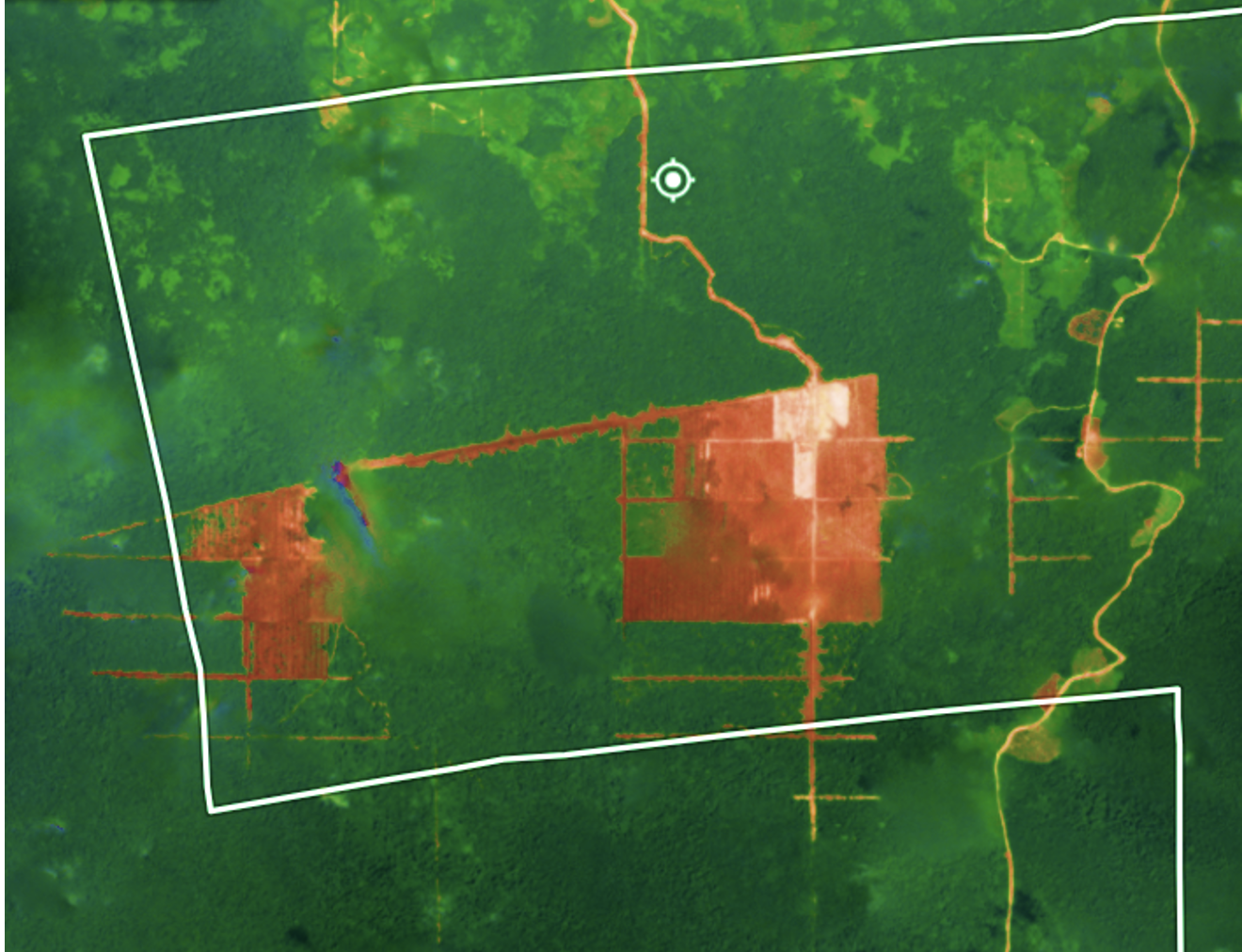
Above is a time lapse of deforestation in First Borneo’s PT Equator Sumber Rezeki concession. Mighty Earth analysis using forest monitoring site Nusantara Atlas identified nearly 1400ha of deforestation in PT ESR between December 2024 and December 2025 (See Planet time lapse imagery below).
As evidenced by the media organization Mongabay in September 2025, Indigenous communities never agreed to allow PT ESR to use their forest. Parts of their land had been included in the concession’s license area without their knowledge or consent. As far as we’re aware, PT ESR has yet to obtain an HGU, or “right to cultivate” permit from the government. Mighty Earth believes this permit should not be granted.
How was First Borneo caught red-handed?
In April 2025, Mighty Earth’s investigation team obtained confidential evidence that two First Borneo concessions (PT BIA and PT KAA) were trading fresh fruit bunches (FFB) to the Damai Group’s PT Samboja Inti Perkasa (PT SIP) mill.
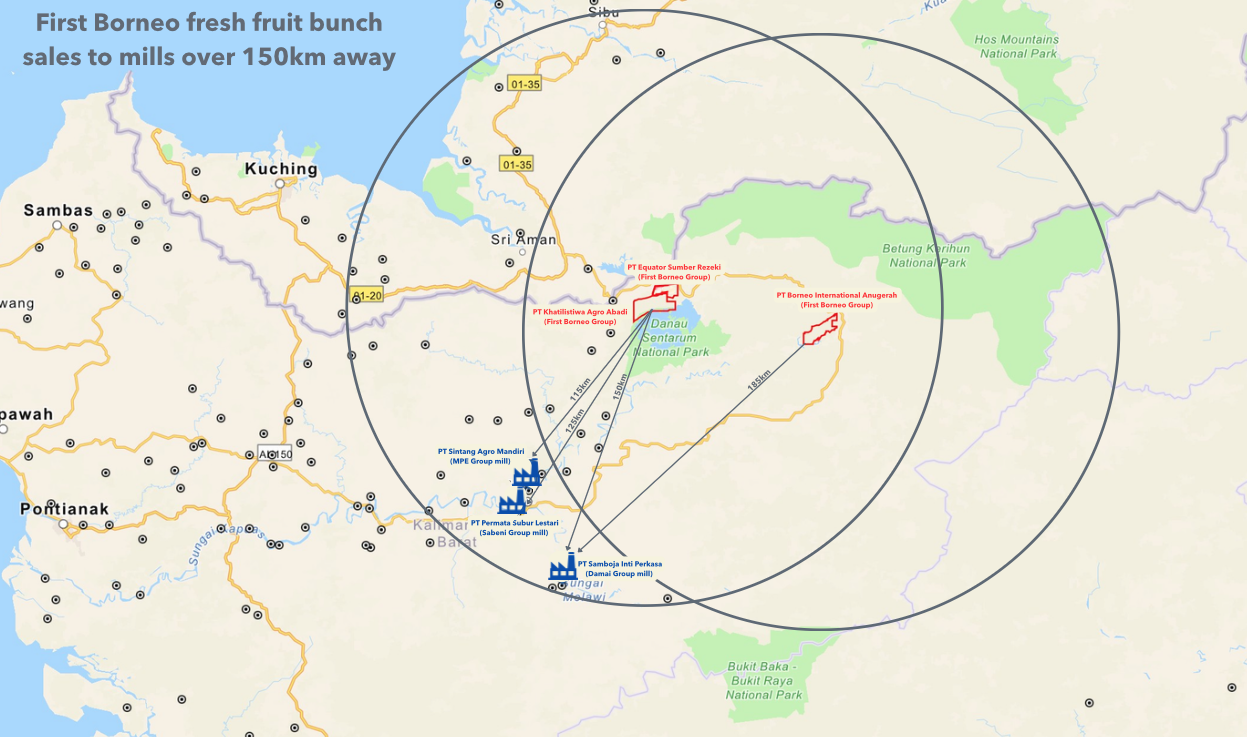
The PT SIP mill is over 350 km by road from the PT KAA concession, demonstrating the great distances that First Borneo is traveling to sell its FFB.
In September 2025, Mighty Earth’s investigation team obtained further evidence that FFB from PT KAA was also being sold to the Sabeni Group’s PT Permata Subur Lestari (PT PSL) mill, nearly 300 kmby road from the PT KAA concession.
In November 2025, Mighty Earth’s investigation team obtained additional evidence that FFB from PT BIA was being sold to MPE Group’s PT Sintang Agro Mandiri (PT SAM) mill, nearly 300 km by road from the PT KAA concession.
Many palm oil companies still consider a 50 km radius (as the ‘crow flies’) as a possible distance for FFB to enter their supply chain. This case acts as evidence that FFB can be transported much further. The map below shows First Borneo concessions PT KAA, PT ESR, and PT BIA selling to mills near and beyond a 150 km radius.
How did palm oil traders respond to Mighty Earth’s evidence on First Borneo?
Through our Rapid Response program, Mighty Earth engaged traders, biofuel producers andconsumer brand companies regarding ongoing deforestation by First Borneo and its FFB trade to mills in West Kalimantan.
Once this new evidence surfaced, the Damai Group’s PT SIP mill (which was found to be sourcing FFB from First Borneo concessions PT BIA and PT KAA) swiftly agreed to stop buying FFB from First Borneo.
Sabeni Group’s PT PSL mill (which was found to be sourcing FFB from PT KAA) agreed to stop sourcing from First Borneo’s PT KAA concession. A key trader, Apical (RGE Group), which sources from all 19 Sabeni Group-owned palm oil mills, has requested that the PT PSL mill conduct ground verification to ensure that any future purchases from First Borneo are stopped.
After evidence was raised of mills in West Kalimantan continuing to purchase FFB from First Borneo’s concessions, companies are now starting to push their suppliers to enforce their No Buy policies with First Borneo.
Several traders, including GAR and Wilmar, agreed to actively engage with the mills and companies connected to these cases of deforestation.
GAR’s grievance log states the following:
Following the [Mighty Earth] report, GAR has reached out to our third party supplier, PT Samboja Inti Perkasa [PT SIP] who allegedly purchase FFB from PT Khatulistiwa Agro Abadi [PT KAA] and PT Borneo International Anugerah [PT BIA]. Based on our intensive discussion, PT SIP have agreed to cease purchases from First Borneo Group.
As a preemptive measure, GAR has circulated a notification letter regarding this non-compliance issue to suppliers located in the radius of the First Borneo Group’s operations (BIA, AUS, ESR, and KAA), informing them that GAR doesn’t accept First Borneo Group product in GAR supply chain.
GAR’s response is particularly important as they have identified the need to expand what they consider to be their ‘sourcing radius’ to 150 KM, allowing them to effectively engage with any possible suppliers from whom they may purchase.
Wilmar told Mighty Earth: ‘We are also aligned on the need to implement risk mitigation measures and have initiated a mapping process to guide further engagement with mills that may be at risk of sourcing from First Borneo.’
Another trader has been investigating the MPE group and its PT SAM mill, stating that they have ‘lodged an investigation and are currently gathering more information regarding the alleged sourcing from First Borneo’. PT SAM claimed they were not sourcing from First Borneo, but when presented with evidence to the contrary, they did not respond. It is unclear whether PT SAM continues to accept FFB from PT BIA.
Furthermore, on December 16, 2025 a trader told Mighty Earth it had been sourcing from two mills in Riau – PT Gemilang Sawit Lestari and PT Mustika Agung Sawit Gemilang (Mustika Agung Group) –which have also been sourcing from First Borneo’s PT Bintang Riau Sejahtera concession in Riau. The trader stated: ‘We detected 2 [Riau] mills that were sourcing from the updated list of First Borneo estates. Since the detection and upon the request of [the company], they have seized FFB sourcing from those said estates.’
However, the continued investigation by Mighty Earth discovered that the PT Mustika Agung Sawit Gemilang mill continued to source FFB from the PT Bintang Riau Sejahtera concession as recently as January 2026.
Companies should investigate that they are not sourcing from mills/groups buying FFB from First Borneo’s PT Bintang Riau Sejahtera concession in Riau.
Any mills sourcing FFB from First Borneo should suspend purchases from any First Borneo concessions or be suspended themselves.
Mighty Earth investigation continues
Several actors in the palm oil industry have been responsive to investigating this Rapid Response case. However, First Borneo’s trade of FFB continues despite the group being on the ‘No Buy Lists’ of multiple palm oil companies and several mills saying they now will not source from the group.Mighty Earth continues to investigate ongoing sales of FFB from First Borneo.
Mighty Earth urges companies to put First Borneo and similarly high-risk groups on ‘No-Buy’ lists and ensure suppliers are strictly enforcing their ‘No-Buy’ policies.
So far, the following companies have communicated to Mighty Earth that they have a ‘No Buy’ policy in place regarding sourcing any palm oil from the First Borneo Group:
Any company sourcing from regions with a high-risk of deforestation like West Kalimantan should be proactively conducting due diligence, ensuring mills are only sourcing from deforestation-free plantations.
With improved road networks in the region, FFB from leakage actors like First Borneo can easily enter supply chains through mills hundreds of kilometers away. Palm oil companies sourcing from mills in West Kalimantan need to conduct due diligence and inform their suppliers within at least a 150 km radius (as the crow flies) of non-compliant entities, including First Borneo.
This case also serves as a clear and recent example of why the European Union DeforestationRegulation (EUDR) is still needed to enforce traceability back to plantations and ensure deforestation-riddled supply does not enter global markets.